Posts
Showing posts with the label George Martin
What was George Martin's 'secret history'?
- Get link
- X
- Other Apps
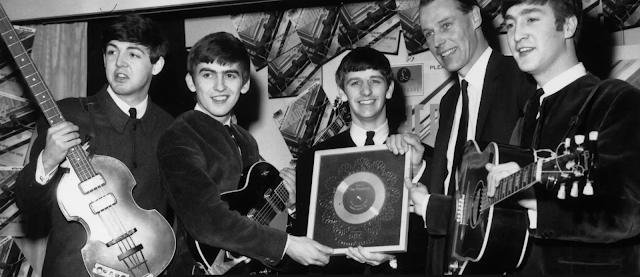
The George Martin who the Beatles first met in 1962 presented as Professor Higgins to their Eliza Doolittle. With his smart suit, upper class (southern) accent and courtly manners he appeared to be what Brian Epstein described as “a stern but fair-minded schoolmaster”. Martin's initial hesitation was due to their personal presentation as much as their musical shortcomings he wasn’t sure about .... shaggy hair, Liverpool accents .... their beat-up gear .... {their}studio professionalism ... source According to Womack, this may have been rooted in his own ‘hidden’ background. For while The Beatles cheerfully conceded what Mark Lewisohn describes as 'their unvarnished working class roots', Martin carefully concealed his. According to Kenneth Womack's biography, Maximum Volume (2017), the suave, sharply dressed producer came from ' a family that had no electricity or running water and had one gas jet.' George Martin - the early years (3 minute free read) T...
Why did George Martin almost not sign The Beatles?
- Get link
- X
- Other Apps
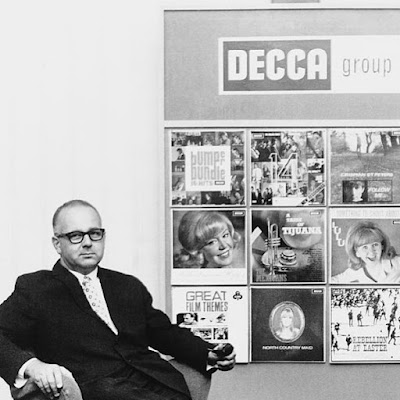
Despite their local success in Liverpool and Hamburg — and Brian Epstein’s best efforts — The Beatles struggled to get their first recording deal. Columbia, HMV, Pye, Philips, and Oriole all turned them down. Dick Rowe at Decca signed Brian Poole and the Tremeloes in preference, famously added insult to injury ‘Guitar groups are on the way out, Mr Epstein’. After the failure of the Decca audition, Brian Epstein was running out of options. Early in 1962 he managed to get a meeting with George Martin, the manager of Parlaphone Records, an eclectic label owned by EMI. Martin was more charmed by the Beatles manager than their music. “I wasn’t too impressed with the tape Brian Epstein had played me,” Martin told Desert Island Discs in 1996 . “There was something there but I couldn’t find out whether it was worthwhile or not.” Read full story here 5 minute free read
Who was the 'fifth Beatle'?
- Get link
- X
- Other Apps
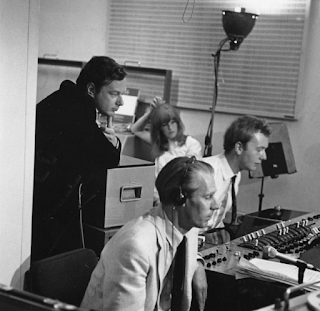
There is a long list of possible candidates, with Brian Epstein a very strong contender. Pete Best also has a claim, as a he was a full band member until August 1962. Musically, however, there is a clear winner and that is the man who offered them their first recording contract and guided them to new frontiers in pop music. When The Beatles entered Abbey Road as very raw musicians without any formal training. They were good live performers but had no experience of working in a studio. None could read music and only Paul had a natural facility for explaining musical ideas in a form that technically trained musicians could follow. Their early compositions had potential but they needed Martin's experience to make them commercial. PLEASE PLEASE ME for example, was initially a Roy Orbison derivative dirge until Martin inspired Lennon to liven it up . The result was The Beatles first number one single. What did George Martin contribute musically? For five years the partnersh...
What is the most recorded song?
- Get link
- X
- Other Apps
Wimpole Street “I woke up with a lovely tune in my head. I thought, ‘That’s great, I wonder what that is?’ There was an upright piano next to me, to the right of the bed by the window. I got out of bed, sat at the piano, found G, found F sharp minor 7th – and that leads you through then to B to E minor, and finally back to E. It all leads forward logically. I liked the melody a lot but because I’d dreamed it I couldn’t believe I’d written it.
Why was Eleanor Rigby a turning point fo The Beatles?
- Get link
- X
- Other Apps
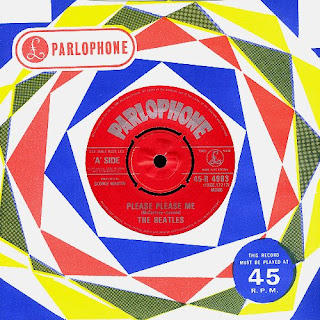
How George Martin transform a 'dirge' into the first Beatles Number 1?
- Get link
- X
- Other Apps
George Martin was initially unconvinced that Lennon & McCartney could consistently write hit songs. For their second single John Lennon put forward Please Please Me - his attempt to channel Roy Orbison. Again the verdict was a resounding thumbs down: I listened to it and I said: 'Do you know that's too boring for words? It's a dirge. At twice the speed it might sound reasonable.' They took me at my word. I was joking and they came back and played it to me sped up and put a harmonica on it. Impressed by the dramatic improvement, George Martin agreed to give the song a second chance. He was not to regret his decision: We worked for ages on their new version of 'Please Please Me', and I said: 'Gentlemen, you're going to have your first #1. Source: Interview with George Martin, The Observer Music Monthly, 2006